
 For the first time in the over 100 year history of UMW we will start large scale composting. UMW produces over 5 tons of food waste a month, this is pre-and-post consumer waste. Previously this food would then go to landfills, a small portion would be rescued and donated, but most would be put into a landfill where it will create methane gas, a greenhouse gas that traps heat in the atmosphere. For at least the next three years we will divert an estimated 150 tons of food from the landfill and instead turn it into beneficial compost. This was all made possible from a grant from the Virginia Department of Environmental Quality.

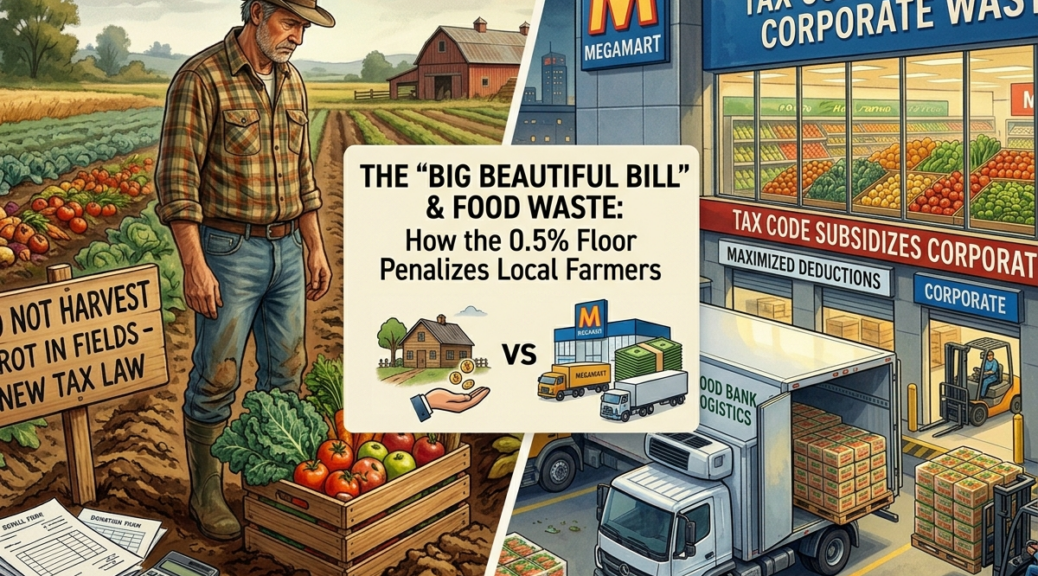
How the “Big Beautiful Bill” harms food donations
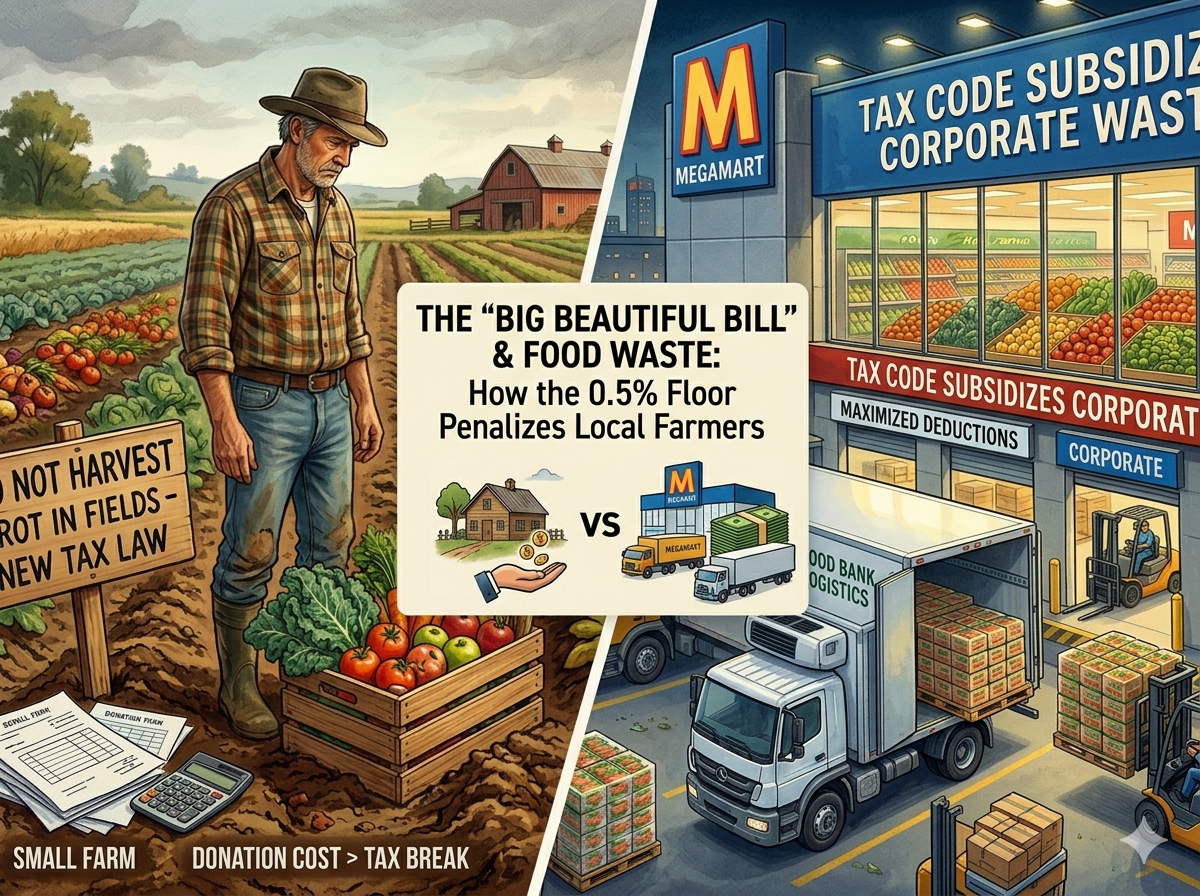 The One Big Beautiful Bill Act (P.L. 119-21) has quietly dealt a heavy blow to local farmers by introducing a charitable deduction “floor” set at 0.5% of a taxpayer’s net income. For independent producers whose farm earnings pass directly to their personal tax returns, this means the first several hundred dollars of any donation yields exactly $0 in tax benefits. While massive corporate grocery chains easily blow past their corporate floors in January and continue writing off systematic overstocking all year long, small-scale farmers are left stranded by the new math.
This policy change creates a brutal financial barrier for local agriculture. Unlike a retailer with boxed goods on a shelf, a farmer must spend substantial out-of-pocket cash on labor, packaging, and fuel just to harvest and transport a crop surplus to a local food bank. Because the new law aggressively clips the value of smaller, sporadic donations, the cost of picking and delivering the food now vastly outweighs the tiny tax savings left over. The tragic, unintended result of the legislation is that it heavily subsidizes corporate food waste while making it too expensive for local farmers to do the right thing, forcing them to leave perfectly good food to rot in the fields.

Ben & Jerry’s creating energy
 When food waste doesn’t decompose properly it creates methane gas which is 10X more potent that carbon dioxide (what burning fossil fuels emits). To take a negative and make it into a positive a Ben Jerry’s (of ice cream) fame is taking that powerful gas to make energy. Check it out: https://youtu.be/XmC8uaon8SY?si=r43AN9G66jhLiK2M

My conversation with the parents of a Heisman winner
A few weeks ago my son and I had the opportunity to meet with the parents of Joe Burrow (Cincinnati Bengals). Joe’s uncle and I used to work toget her. His parents were incredibly down-to-earth and humble. We talked quite a bit about parental involvement in Joe’s development as a young athlete.
They emphasized that they were very hands-off during games—they didn’t yell or try to coach from the sidelines (even though Joe’s dad was a professional coach). They were always encouraging, never frustrated, and avoided pointing out mistakes. The only time they were firm with Joe was when it came to poor sportsmanship. They also shared that even today, Joe hears their voices during games after a bad play, he can hear them telling him to shake it off and move on.
I wanted to share this because, as you know, parents can often be very active in their children’s development. Coaches do their best to manage this, but it may be helpful to re-emphasize how words of encouragement can help players, while criticism—especially during games—can be harmful.
Another thing that stood out was the emphasis on playing multiple sports. Joe played football, basketball, and baseball growing up. He dropped baseball in high school but didn’t specialize in football until college. They felt that switching between sports really helped his development and kept football enjoyable.

Is the social media ban (Australia) really a bad thing?
 I asked my Digital Marketing class of about 50 students (mostly 20 – 22 years old with equal gender representation) the following question: “Go back to when you were 13 years old. What would you tell 13-year-old you about social media that you know now?”
Overwhelmingly the views on social media were negative, nobody said they wish they spent more time on it, nobody said it made their life better, nobody talked about how great it is. On the contrary, people used words such as addiction, mental health, and self worth. I compiled the results in this document. What would you tell 13 year old you about social media
