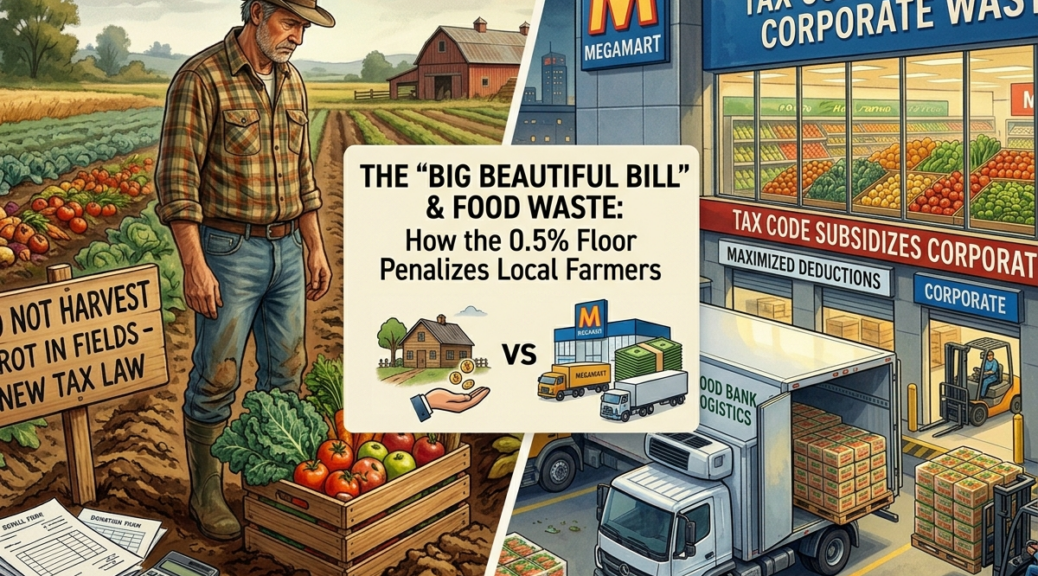
The One Big Beautiful Bill Act (P.L. 119-21) has quietly dealt a heavy blow to local farmers by introducing a charitable deduction “floor” set at 0.5% of a taxpayer’s net income. For independent producers whose farm earnings pass directly to their personal tax returns, this means the first several hundred dollars of any donation yields exactly $0 in tax benefits. While massive corporate grocery chains easily blow past their corporate floors in January and continue writing off systematic overstocking all year long, small-scale farmers are left stranded by the new math.
This policy change creates a brutal financial barrier for local agriculture. Unlike a retailer with boxed goods on a shelf, a farmer must spend substantial out-of-pocket cash on labor, packaging, and fuel just to harvest and transport a crop surplus to a local food bank. Because the new law aggressively clips the value of smaller, sporadic donations, the cost of picking and delivering the food now vastly outweighs the tiny tax savings left over. The tragic, unintended result of the legislation is that it heavily subsidizes corporate food waste while making it too expensive for local farmers to do the right thing, forcing them to leave perfectly good food to rot in the fields.
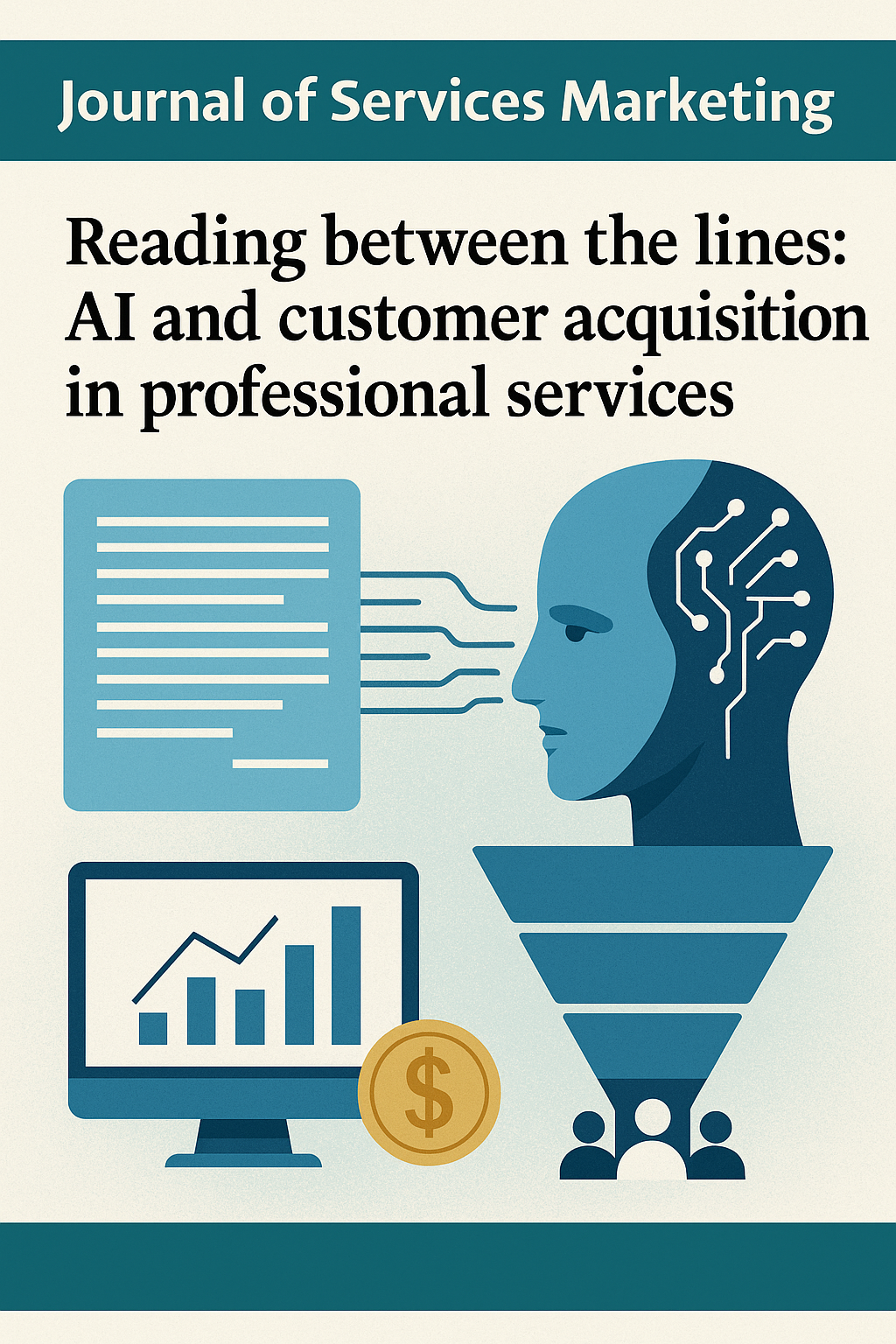
Do you like this AI image? My colleague Michel Laroche and I recently completed a study where we used AI to examine what customers aid to a professional services firm. We found that AI did a great job predicting what customers were more likely to purchase based on the specificity they used in their words. A link to the paper is here: JSM756356 – Proof.
My colleague Michel Laroche (Concordia) are exploring how AI can be trained to identify where someone is in the sales funnel and whether they are more likely to purchase. For professional service firms (like a home improvement firm), prospective customers will communicate to the from the firm what they want. For example, I may say that I want to remodel my master bathroom. Our research question is whether AI can look at these words to help predict whether a customer will accept the proposal and purchase from company. We recently presented this work at the AMA Winter Educators Conference in Phoenix, February 16, 2025. A copy of the presentation can be found here. Leveraging AI to predict customer acquisition – v1
If you have ever had a passing interest in digital marketing (or marketing) you’ve heard of the marketing funnel. Consumers at the top are gaining awareness while those at the bottom are most likely to purchase. The funnel shape because there are a lot more consumers at the top than there are at the bottom. When consumers approach a professional service firms they often communicate where they are in the sales funnel. For example, a customer may tell a contractor that they want to have their kitchen redone and they want the work done by the end of next month. Another consumer may approach the firm and say that they are exploring some renovations in their kitchen. Clearly, the former customer is further down the funnel than the latter. Research that my co-author (Michel Laroche) and I are currently pursuing examines how AI can use these words to determine where the customer is in the sales funnel. Once customers are identified in different parts of the funnel, the firm can use different marketing approaches.
If a car is made incorrectly and it becomes a safety hazard who is liable for getting it fixed. The car needs to be fixed and manufacturers are responsible for making those repairs (free of charge to the consumer) but what if the consumer doesn’t want to get the car fixed. Getting your car fixed is time consuming. You have to schedule time to bring it in, wait while it’s being repaired, and in some cases have no car for days while the repairs are made. It’s not something consumers enjoy doing so many avoid having their car fixed when a recall occurs. The result is that there are potentially dangerous cars on the road because consumers don’t want to get them fixed. Should consumers be punished if they don’t bring their cars in for repairs? In Britain consumers can have their cars impounded if the repairs aren’t made, in the U.S consumers can’t be punished if they choose not to bring their cars in for repairs. In a paper I co-authored with Hair Bapuji (U Melbourne), we found that when consumers can be punished it compels firms to issue a recall faster and avoid bigger problems. The paper is forthcoming in the Journal of International Business Policy, 2024-02-09 Consumer Liability and Responsiveness – JIBP – Accepted Manuscript
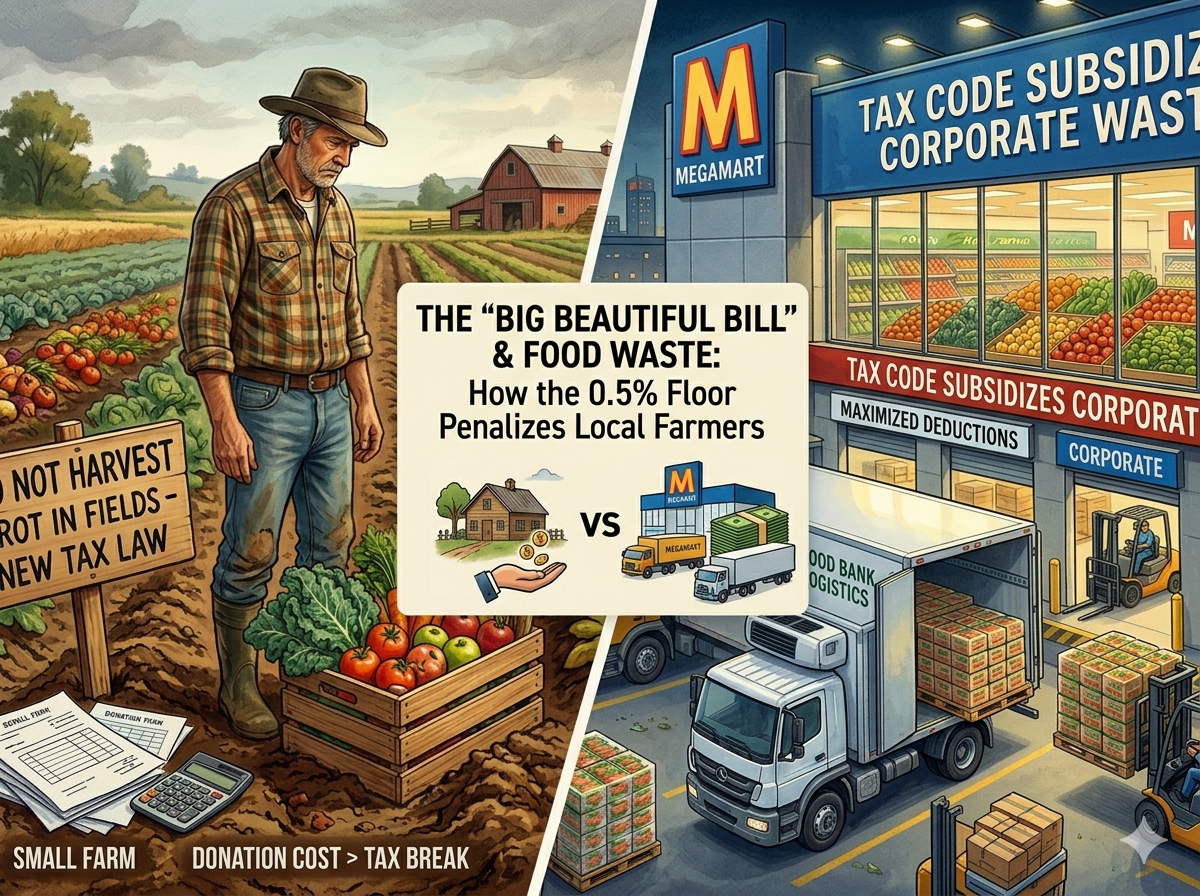 The One Big Beautiful Bill Act (P.L. 119-21) has quietly dealt a heavy blow to local farmers by introducing a charitable deduction “floor” set at 0.5% of a taxpayer’s net income. For independent producers whose farm earnings pass directly to their personal tax returns, this means the first several hundred dollars of any donation yields exactly $0 in tax benefits. While massive corporate grocery chains easily blow past their corporate floors in January and continue writing off systematic overstocking all year long, small-scale farmers are left stranded by the new math.