The One Big Beautiful Bill Act (P.L. 119-21) has quietly dealt a heavy blow to local farmers by introducing a charitable deduction “floor” set at 0.5% of a taxpayer’s net income. For independent producers whose farm earnings pass directly to their personal tax returns, this means the first several hundred dollars of any donation yields exactly $0 in tax benefits. While massive corporate grocery chains easily blow past their corporate floors in January and continue writing off systematic overstocking all year long, small-scale farmers are left stranded by the new math.
This policy change creates a brutal financial barrier for local agriculture. Unlike a retailer with boxed goods on a shelf, a farmer must spend substantial out-of-pocket cash on labor, packaging, and fuel just to harvest and transport a crop surplus to a local food bank. Because the new law aggressively clips the value of smaller, sporadic donations, the cost of picking and delivering the food now vastly outweighs the tiny tax savings left over. The tragic, unintended result of the legislation is that it heavily subsidizes corporate food waste while making it too expensive for local farmers to do the right thing, forcing them to leave perfectly good food to rot in the fields.
If a car is made incorrectly and it becomes a safety hazard who is liable for getting it fixed. The car needs to be fixed and manufacturers are responsible for making those repairs (free of charge to the consumer) but what if the consumer doesn’t want to get the car fixed. Getting your car fixed is time consuming. You have to schedule time to bring it in, wait while it’s being repaired, and in some cases have no car for days while the repairs are made. It’s not something consumers enjoy doing so many avoid having their car fixed when a recall occurs. The result is that there are potentially dangerous cars on the road because consumers don’t want to get them fixed. Should consumers be punished if they don’t bring their cars in for repairs? In Britain consumers can have their cars impounded if the repairs aren’t made, in the U.S consumers can’t be punished if they choose not to bring their cars in for repairs. In a paper I co-authored with Hair Bapuji (U Melbourne), we found that when consumers can be punished it compels firms to issue a recall faster and avoid bigger problems. The paper is forthcoming in the Journal of International Business Policy, 2024-02-09 Consumer Liability and Responsiveness – JIBP – Accepted Manuscript
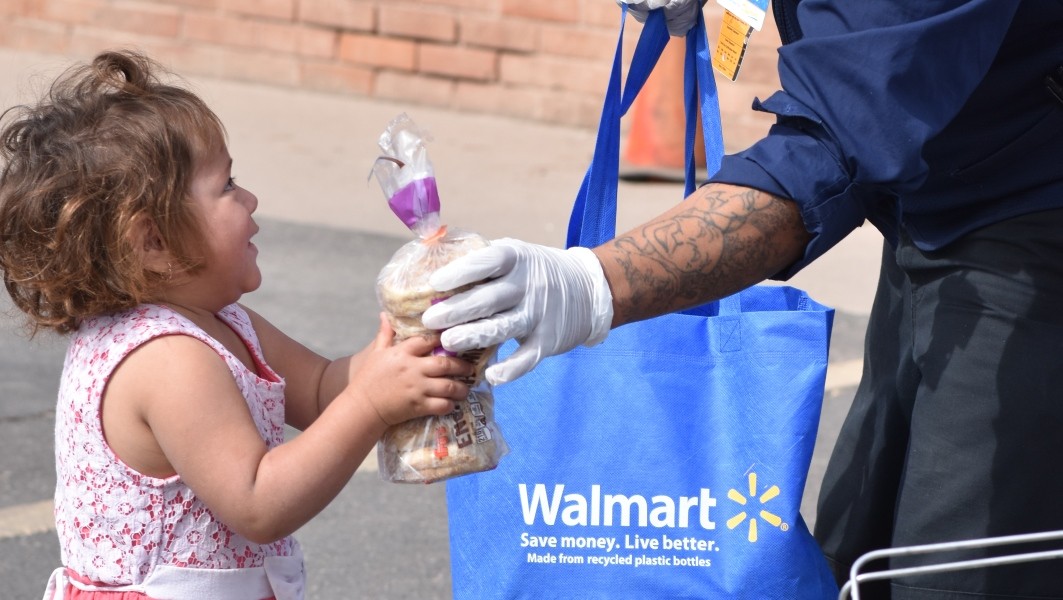
Firstly, I completely agree that if food prices are lower then more people will be able to afford food. I do not refute this robust finding at all. I was given data on donations to food banks and found that overall, lower priced retailers (such as Aldi and Wal-Mart) would donate greater volume over the course over the year. However, when higher priced retailers (Publix or Wegmans) donate they give a greater volume of donation than a lower priced retailer. For example, if Wal-Mart gives a donation at 10am on Monday and Wegmans gives a donation at 10am on Monday then it’s likely that Wegmans will have given more. I also found that higher priced retailers would give a greater value of goods per donation (e.g. more higher priced goods). So, can higher prices help, partly yes because higher priced retailers are more likely to give greater volume of food to food banks (per donation).
Also, if you are curious. The lowest priced retailer in our sample was BJ’s Wholesale Market while the highest priced retailer was Publix (Wal-mart was the 6th cheapest out of 11 retailers). The greatest volume of donations came from Wal-Mart.
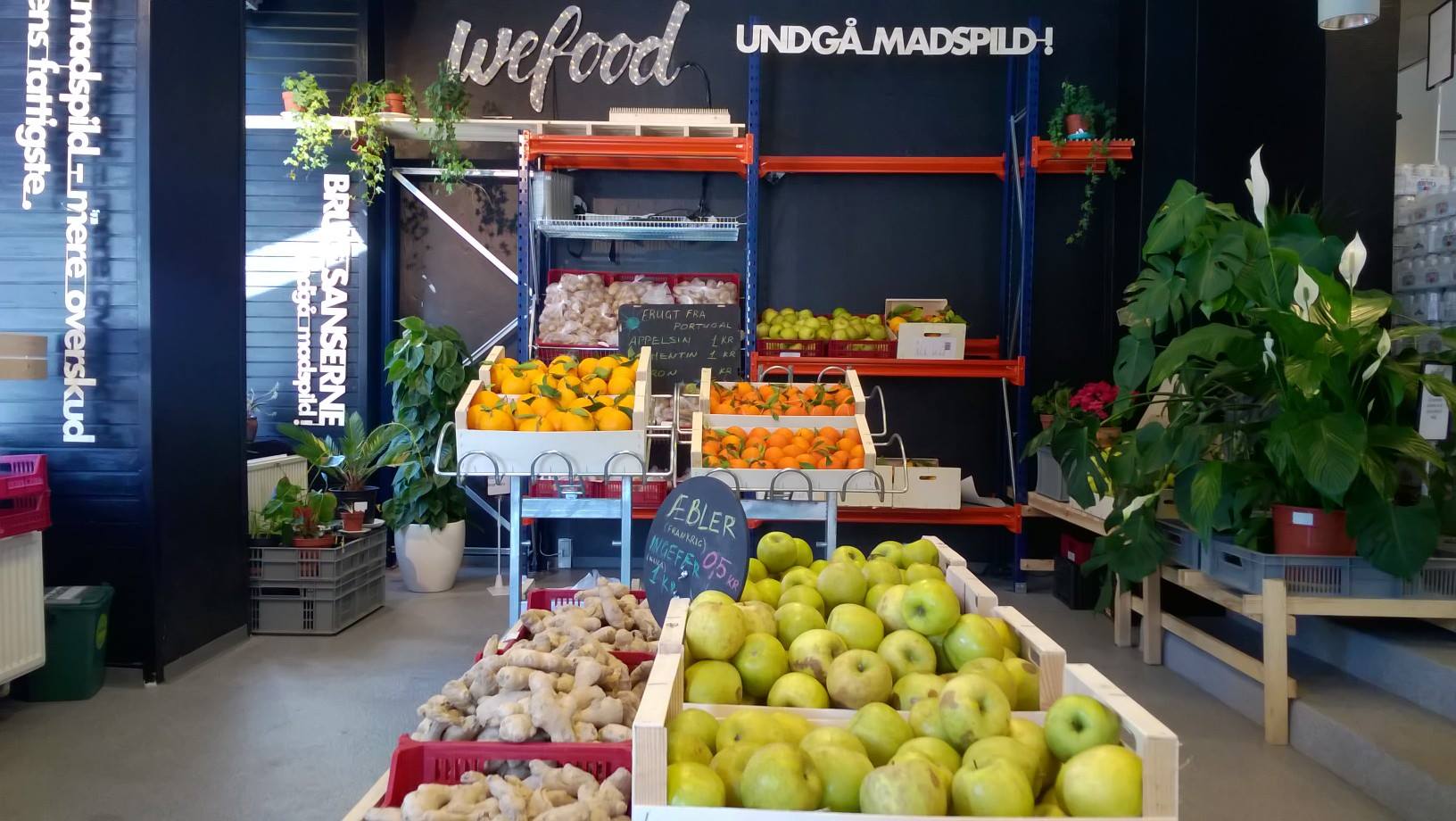
Around the world, policies are taking direct steps to reduce food insecurity. In France, commercial food waste is banned. Denmark has a grocery store that sells imperfect foods (cans that are dented, etc.) at large discount. The following is an article from the CBC that outlines some great examples of programs and policies that try to alleviate food insecurity. https://www.cbc.ca/news/food-insecurity-solutions-1.7043468
This coming semester will be the second edition of our Alleviating Food Waste class. Last year we partnered with the Fredericksburg Food Co-op to study the types of food that are most often discarded (primarily due to expiration dates). This semester we added the Fredericksburg Food Bank and Sodexo (which operates our school dining halls). We’re also incorporating more work from the realm of nutrition. As word spreads about the positive impact of the course we’re expanding our partnerships which becomes a win-win. Students learn the latest on this massive problem and we reduce waste at home and through our partnerships. A win-win collaboration at a school that is known for it’s small class sizes and community engagement.
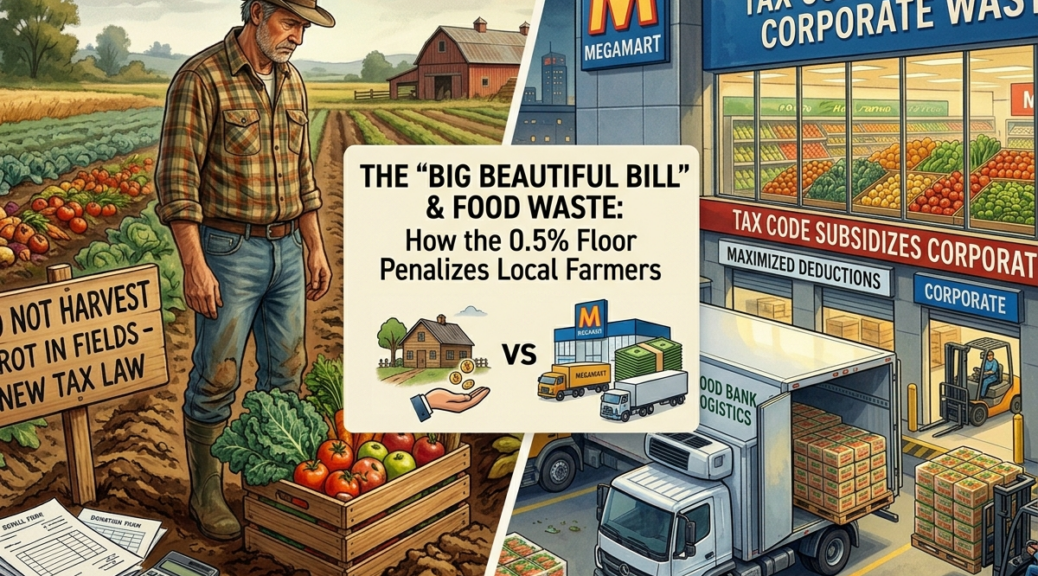
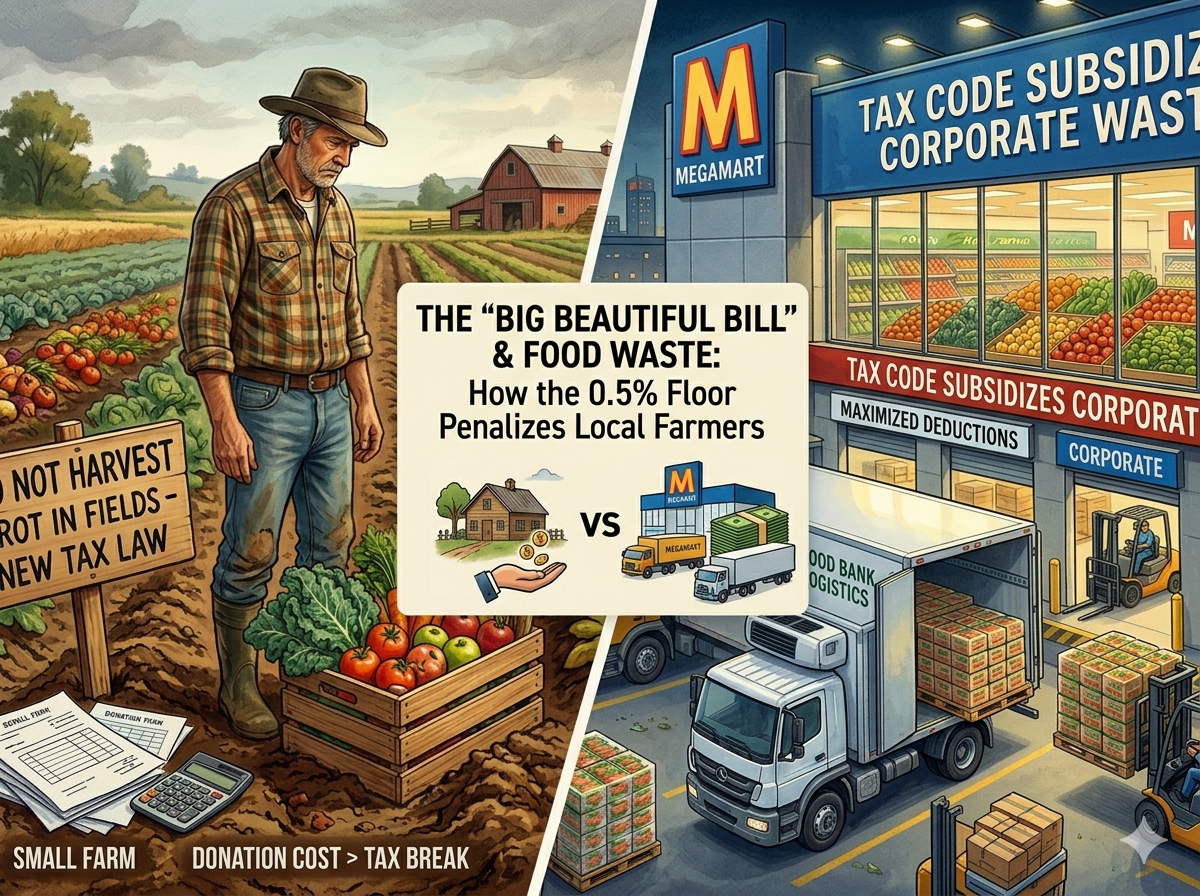 The One Big Beautiful Bill Act (P.L. 119-21) has quietly dealt a heavy blow to local farmers by introducing a charitable deduction “floor” set at 0.5% of a taxpayer’s net income. For independent producers whose farm earnings pass directly to their personal tax returns, this means the first several hundred dollars of any donation yields exactly $0 in tax benefits. While massive corporate grocery chains easily blow past their corporate floors in January and continue writing off systematic overstocking all year long, small-scale farmers are left stranded by the new math.